Vietnam is entering an era of comprehensive infrastructure breakthroughs, with a series of mega-projects involving expressways, international seaports, thousand-hectare industrial parks, and renewable energy ecosystems kicking off simultaneously. Behind this rapid growth picture lies the fundamental pressure of transport: how to safely move massive, monolithic industrial structures – “steel giants” that cannot be dismantled or transported by conventional methods.
This poses a brain-straining puzzle for the domestic logistics industry. Do Vietnamese enterprises possess enough technical capacity and resilience to shoulder the entire flow of a rising industry? Let’s sit down with Mr. Doan Chien Thang, Project Sales Manager at VIETRANSTIMEX, to explore the unique requirements of Transporting Oversized and Heavy Cargo, as well as the driving factors behind the journey to bring Vietnamese technical capabilities to the global stage.
Click here to watch the full interview with English subtitles.
Ensuring Absolute Safety and Strict Schedules is the Lifeline
Interviewer: Hello Mr. Thang. Thank you for taking the time to join our discussion today.
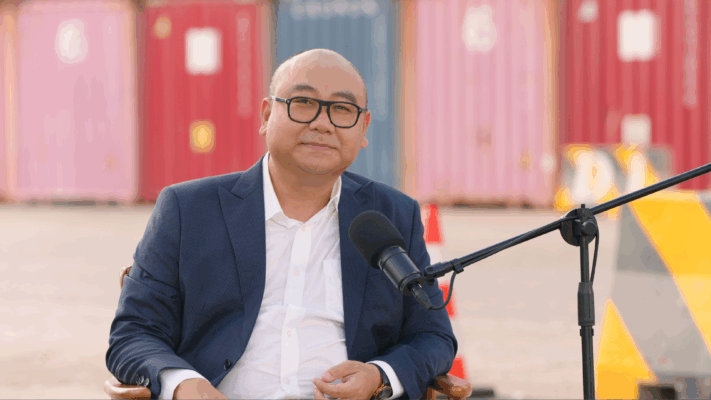
Mr. Doan Chien Thang: Hello. I am Doan Chien Thang, currently the Project Sales Manager at VIETRANSTIMEX Multimodal Transport Joint Stock Company, specializing in oversized, heavy cargo transport and oil and gas equipment. It is my great pleasure to share insights into this specialized field.
Interviewer: When thinking of oversized and heavy cargo, many people usually imagine items of enormous size and weight. From a technical perspective, what are the core characteristics that differentiate this type of cargo from standard goods?
Mr. Doan Chien Thang: At VIETRANSTIMEX, cargo classified as oversized and heavy typically possesses unique technical attributes.
First, these items usually weigh 100 tons or more and are designed as monolithic, non-dismantlable units. Therefore, load calculations and transport planning must achieve an exceptionally high level of precision.
Second, the transport process requires specialized equipment system such as hydraulic trailers or Self-Propelled Modular Trailers (SPMTs). These vehicles are capable of self-balancing, ensuring the cargo remains perfectly stable throughout the journey, even on complex terrains.
Another crucial requirement is timeline management. Typically, we need 3 to 6 months to conduct site surveys, engineer technical solutions, and mobilize equipment. However, once we enter the actual execution phase, the transport process usually takes only 5 to 7 days, or a maximum of about two weeks, depending on the scale and conditions of each project.
Finally, there are stringent standards from clients. Most of our partners are major conglomerates from Europe and Japan, or leading domestic oil and gas enterprises like PTSC and Vietsovpetro. These units all set exceptionally high bars for safety, progress, and execution quality.
Interviewer: Does that mean legal and safety compliance are always given the highest priority?
Mr. Doan Chien Thang: Exactly. At VIETRANSTIMEX, every transport plan must pass a multi-layered control process. After our engineering team finalizes the technical method, an independent marine warranty surveyor (MWS) representing the insurance provider will audit all safety factors and feasibility before the project receives green-light approval for execution.
Furthermore, all personnel and equipment involved must undergo rigorous inspection procedures before entering the site to ensure they fully meet all safety and operational mandates.
Interviewer: So, even when VIETRANSTIMEX has engineered an optimal plan, the project must still be audited by an independent third party before execution?
Mr. Doan Chien Thang: That is correct. The involvement of an independent surveyor provides an objective assessment of whether the transport plan is truly optimized and fully compliant with safety regulations.
In this field, safety and schedule are always the two paramount factors. Oversized and heavy components are usually of immense value, and their manufacturing timeline can stretch up to years. Therefore, the transportation process leaves no room for error. Every single item must be thoroughly prepared, fully verified, and approved according to the strictest standards before execution.
05 Core Competencies in Executing Oversized and Heavy Cargo Projects
Interviewer: Transporting monolithic components weighing from hundreds to thousands of tons always carries inherent risks. In your opinion, what are the core factors that enable a business to successfully execute projects with such specialized technical requirements?
Mr. Doan Chien Thang: Based on our experience, successfully executing oversized and heavy cargo projects requires a combination of 5 core elements:
- Engineering Solution Capacity: Every project has unique construction conditions, cargo specifications, and technical requirements. Therefore, the engineering team must research, calculate, and develop tailored transport solutions that meet safety requirements while ensuring cost-efficiency for the client.
- Highly Experienced Technical Team: Advanced equipment only maximizes its efficiency when operated by a team with expertise and hands-on experience. During execution, unforeseen on-site situations are inevitable. Practical experience enables the technical team to deliver appropriate handling methods, ensuring project progress and safety.
- Specialized Equipment Fleet: Actively investing in and directly operating a specialized transport fleet gives the company greater flexibility in resource mobilization, allowing us to select the perfect equipment combination for each cargo type and site condition.
- Timeline Management Capability: For large-scale projects, keeping up with the schedule is a critical requirement from developers. Right from the preparation phase, we build a detailed execution plan with specific milestones and closely monitor progress throughout the process to ensure the project runs as scheduled.
- Safety and Legal Compliance Capability: The entire fleet, workforce, and construction process must fully comply with legal regulations, technical standards, and safety requirements set by the developer and the surveyor. This is a mandatory prerequisite before any project can kick off.
Technical Solutions Born from Project Reality
Interviewer: You mentioned that engineering solution capacity is a core factor. Could you share a signature project that illustrates this?
Mr. Doan Chien Thang: A prime example is the project to transport 51 suction bucket foundations from Ba Son Port to PTSC Vung Tau Port in 2024. This was evaluated as one of the oversized-heavy cargo transport projects with the largest scale and strictest technical standards in Vietnam at the time.
The primary challenge lay in the load-out phase onto the barge. According to the conventional method, the barge would berth perpendicular to the jetty for loading. However, after site surveys and actual condition analysis, we identified two main limitations: first, mobilizing equipment and organizing construction would incur massive costs; second, a perpendicular berth would significantly block the marine channel, affecting the traffic of other vessels in the area.
To prevent any unwanted incidents, our technical team proposed an innovative solution: berthing the barge longitudinally (parallel to the jetty) and performing a roll-on/load-out operation horizontally.
To execute this method, we performed numerous highly detailed weight calculations and load simulations to ensure the barge maintained its highest state of balance while receiving the heavy structures from the side.
Following a technical review and assessment, the method was approved by the client. The actual execution took place safely, meeting all technical requirements, while optimizing costs and minimizing disruptions to maritime operations in the area.
Interviewer: Could you share more about the scale of the components in this project so our readers can better visualize them?
Mr. Doan Chien Thang: These were suction bucket components serving an offshore wind project in Taiwan. Each structure had a diameter of about 15 meters, a height ranging from 15 to 17 meters, and a weight of 325 to 450 tons. To meet the project timeline, VIETRANSTIMEX arranged a transport plan to carry three structures simultaneously per barge trip.
Interviewer: So the total cargo volume per trip reached nearly 1,500 tons at times?
Mr. Doan Chien Thang: That’s right. Each transport trip carried a total payload of nearly 1,500 tons, and the operation was executed continuously until all 51 components were successfully delivered on schedule.
Interviewer: The project transporting 51 suction buckets, a brilliant milestone for VIETRANSTIMEX in the offshore wind sector, clearly posed massive technical and operational demands. Aside from this, what other recent projects have brought similar complexity or unique challenges to your team?
Mr. Doan Chien Thang: Another proud milestone was the transport of 4 Topside Modules for the Kinh Ngu Trang (White Whale) project, executed in the second quarter of 2025. Among them, the lightest component weighed around 1,500 tons, while the largest reached a staggering 3,860 tons.
This is one of the heaviest payloads ever directly handled by a Vietnamese engineering and technical team. Previously, for structures of this scale, developers would typically hire foreign contractors. However, in this project, the entire scope of engineering calculations, equipment operation, and transport execution was managed by the VIETRANSTIMEX team, using 100% Vietnamese-owned equipment and 100% Vietnamese technicians directly calculating and operating.
For us, this was not just a project with high technical requirements, but also a testament to the trust that client Vietsovpetro placed in VIETRANSTIMEX. Within just about half a month, all 4 topside modules were safely loaded onto the barge to be transported to their offshore installation site.
Gearing Up Capabilities for Ever-Growing Projects
Interviewer: Along with the growth of infrastructure and energy, the scale of future components will undoubtedly continue to increase in both size and weight. How is VIETRANSTIMEX preparing to capture this trend?
Mr. Doan Chien Thang: We determine that investment must be made synchronously across both equipment and human resources.
Regarding equipment, VIETRANSTIMEX continues to invest in specialized vehicles and heavy-lift systems to meet the requirements of transporting components with ever-larger dimensions and payloads, while enhancing execution efficiency.
On the human resource side, our engineers are continuously trained and upskilled to enhance their capacity in building technical methods and handling increasingly complex project requirements. We also regularly organize on-the-job training programs, combined with real-world execution, so that our technical team can step-by-step master new transport technologies and methodologies.
Interviewer: Thank you, Mr. Doan Chien Thang, for your highly specific and insightful insights. We hope today’s discussion helps readers better understand the technical requirements and the execution capabilities behind oversized, heavy transport projects.
————-
Produced and edited by SOTRANS Group
|
The ‘Logistics Anchor’ podcast series, a place to share real-world stories from the SOTRANS Group team, a corporation with over 50 years of experience in the logistics sector in Vietnam. Here, every supply chain challenge is viewed through the lens of a practical problem, where solutions are directly tied to operations and the actual needs of businesses. Watch the full series here. |
(SOTRANS Group News)