Within the logistics ecosystem, Plastic Resin Logistics is one of the most demanding specialties. Although plastic resins may seem straightforward at first glance, they actually present highly challenging operational puzzles. Despite not being fragile or requiring cold storage, plastic resins are exceptionally “sensitive” to factors such as moisture, static electricity, and sunlight. Managing the delivery of hundreds of thousands of tons of raw materials to factories right on schedule while fully preserving their technical specifications is a true art of methodical supply chain management.
Amid the wave of green transition and increasingly stringent trade barriers, the Vietnamese plastics industry is undergoing a powerful transformation, ranging from process automation to rigorous tracking of material origins. This is also the defining moment for logistics enterprises to assert their adaptability, serving as a strategic “anchor” for their clients.
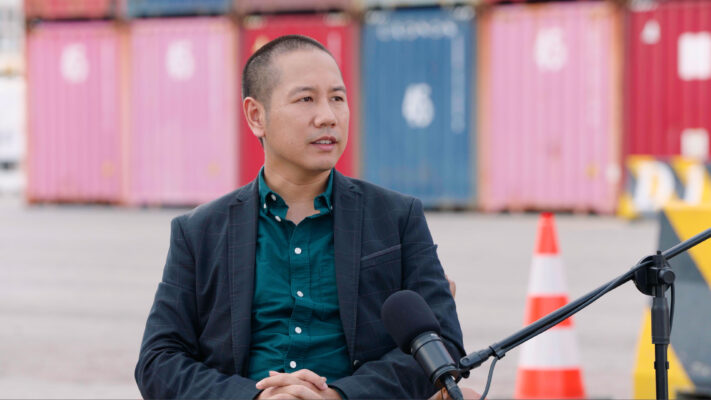
Below are the in-depth insights shared by Mr. Luu Thanh Trung (Raul Trung) – Sales Director of SOTRANS Logistics, regarding the journey to optimize the supply chain for this key industry.
Click here to watch the full interview with English subtitles.
Plastic Resin Logistics Under Market Pressure and Escalating Costs
Interviewer: Welcome, Mr. Trung, to our program.
Mr. Luu Thanh Trung: Hello, readers. I am Raul Trung, Commercial Director at SOTRANS Logistics. It is a great pleasure to be here today to discuss the operational characteristics and logistics solutions for the plastic raw materials sector—an industry experiencing impressive growth in Vietnam.
Interviewer: The plastics industry plays an essential role and serves as a primary input link for almost all key sectors, ranging from fast-moving consumer goods (FMCG) and agriculture to automotive and construction. How do you assess the current overview of this industry in Vietnam?
Mr. Luu Thanh Trung: The plastics industry has always been a foundational sector with a long-standing history in Vietnam. We easily encounter the presence of plastic products in every aspect of life, from everyday consumer goods like footwear and bottles to traditional agricultural packaging. However, over the past decade, we have witnessed a spectacular leap in the production of plastic raw materials in Vietnam.
This breakthrough stems from a powerful wave of Foreign Direct Investment (FDI). Today, the Vietnamese market records the participation of major domestic and international corporations, contributing significantly to the export turnover of plastic raw materials. Prominent domestic names include An Thanh Bicsol and A Dong (ADG), alongside global giants such as SCG International (Thailand) with its Long Son Petrochemicals Complex, and Hyosung Chemical Group (South Korea)—all creating new growth drivers for the entire industry.
The growth figures clearly demonstrate the immense potential of the Vietnamese plastics industry. In 2025, the industry’s total revenue reached 32 billion USD with a total market output of 11.84 million tons, of which export turnover made a spectacular breakthrough, bringing in over 7.47 billion USD. Moving into 2026, the overall market output is forecasted to expand robustly, heading towards a milestone of over 12.8 million tons while maintaining a stable revenue growth rate of 6% to 8%.
In terms of market structure, Vietnam’s plastic raw materials industry has shifted toward diversification. It is no longer reliant on a single region but has expanded its reach to over 170 countries and territories. The export market share is now quite evenly distributed: Southeast Asia accounts for about 37%, the Middle East and South Asia make up 32%, and the remaining portion belongs to stringent markets like the EU and the US with over 30%.
Interviewer: It is evident that the demand for logistics within the Southeast Asian market in general, and Vietnam in particular, is growing very strongly. In your opinion, what are the noteworthy operational characteristics when providing logistics services for the plastics industry?
Mr. Luu Thanh Trung: By nature, plastic resins are downstream products of the chemical and petrochemical refining industries. Therefore, the most critical characteristic in plastics logistics operations is strict compliance with legal regulations and technical standards. Everything from material composition and quality standards to environmental impact factors must be rigorously controlled.
For the supply chain to run smoothly without disruption, logistics service providers must possess a profound understanding of the entire process: from inbound raw materials (whether imported or domestic) to production supply and final product export.
Optimizing Customs Processes: A Solution to Prevent Financial Losses from Production Disruptions
Interviewer: Based on market realities, many businesses believe that customs procedures are one of the biggest bottlenecks for importing plastic raw materials. What solutions has SOTRANS implemented to help enterprises overcome these obstacles, sir?
Mr. Luu Thanh Trung: In practice, just a minor error or a lack of synchronization during the declaration process can lead to the detention of an entire shipment. The subsequent consequence is a disruption of the factory’s entire production line, causing immense economic losses due to machine downtime costs, demurrage and detention (DEM/DET) fees, and delays in the overall business plan.
A costly lesson occurred during the 2017–2018 period, when a massive volume of recycled plastics (in the form of scrap) flooded into Vietnam but failed to meet strict environmental standards. This resulted in severe congestion at Cat Lai and Hai Phong ports that dragged on for a whole year. This incident not only placed tremendous pressure on port infrastructure but also pushed many manufacturing enterprises into a difficult position due to a critical shortage of inbound raw materials.
Understanding these risks, SOTRANS always prioritizes accuracy and legal safety. We have established a rigorous quality control process and do not allow errors at any stage. SOTRANS’s specialized team regularly participates in intensive training programs to promptly grasp the latest Circulars, Decrees, and technical standards issued by the Government and relevant Ministries.
We exercise strict control over the documentation from the export stage overseas until the cargo arrives at international ports in Vietnam. All paperwork, Certificates of Origin (C/O), and Certificates of Quality (C/Q) must be thoroughly reviewed and ensure absolute compliance before transmitting the official customs declaration. This proactive management solution ensures that our clients’ cargo flows are always cleared quickly and safely, while optimizing cargo release time.
Safety Commitment from Field Operational Excellence and Specialized Technical Equipment
Interviewer: In addition to regulatory and customs bottlenecks, what specific technical challenges does field transportation for this specialized commodity usually face, sir?
Mr. Luu Thanh Trung: To optimize transportation workflows and reduce costs for our clients, SOTRANS proactively categorizes plastic raw materials into two main groups, each with its own distinct technical handling methods: virgin plastics and recycled plastics.
Virgin plastic products are typically in powder or fine granule form. To optimize volume capacity and save packaging costs, modern factories often adopt the Bulk-in-Container method instead of traditional small-bag packaging. In this scenario, the container shell essentially acts as a giant layer of packaging. The greatest challenge arises when the container is transported from the port to the factory, requiring a specialized tipping platform to tilt the container and discharge the materials into the feeding silos. For factories with pre-existing infrastructure, this unloading process is seamless. However, for factories lacking fixed lifting and unloading equipment, SOTRANS has thoroughly resolved this puzzle by investing in a fleet of specialized tipping chassis. This equipment can automatically tilt containers similarly to the mechanism of a dump truck, ensuring a smooth direct bulk unloading process and maintaining continuous factory production, even if the client has not yet invested in infrastructure equipment.
For recycled plastic products such as plastic bags, shredded plastic bottles, or plastic flakes, the cargo is usually packed in oversized and heavy Jumbo bags (FIBC). When transported by container to the factory warehouse, stripping the cargo requires specialized forklifts and cranes. SOTRANS always proactively surveys the site and prepares these auxiliary equipment to ensure the unloading process takes place with maximum safety and efficiency.
Notably, Vietnam’s export turnover for plastic resins is currently massive. Mega-factories frequently handle large-scale orders ranging from thousands to tens of thousands of tons. In such cases, transportation via Bulk Vessels is the most cost-effective choice.
However, the difficulty then lies in the short-haul drayage from the factory to the port. We must utilize flatbed trailers, which are completely open vehicles without fixed sideboards. Each trip typically carries 25 to 30 Jumbo bags, with each bag weighing between 1.2 and 1.5 tons. Stacking these heavy cargo blocks onto an open flat surface demands exceptionally solid weight distribution, arrangement, and lashing techniques. This ensures the cargo remains absolutely secure, balanced, and free from shifting or falling throughout the road transit.
Interviewer: For shipments weighing dozens of tons positioned on an open surface without sideboards like flatbed trailers, what measures does SOTRANS apply to control risks and ensure absolute safety?
Mr. Luu Thanh Trung: Cargo arrangement and lashing techniques are necessary conditions, but the capability and sense of responsibility of the drivers are the ultimate pivotal conditions. At SOTRANS, we do not define a driver merely as someone who operates a mechanical vehicle. Our driving team must undergo a highly rigorous recruitment and training process. Periodically once or twice a month, we organize training sessions to enhance field skills, update documentation procedures, and ensure strict compliance with the distinct safety regulations of each factory or operating port.
SOTRANS drivers are intensively trained to maintain steady speeds, master space management, and execute proper cornering techniques. This minimizes sudden braking to reduce the inertial force acting on the stacked cargo structure. We are fully aware that each shipment is not just about moving materials, but also about protecting commercial reputation and the continuity of our clients’ supply chains. Therefore, the professionalism, dedication, and high expertise of the SOTRANS driving team serve as our strongest commitment to the safety of every shipment.
Interviewer: As you just shared, alongside equipment infrastructure, the human element, particularly the driving team, plays a core role in cargo safety. In actual resource dispatching, does SOTRANS encounter any significant barriers, and what is the company’s counter-strategy?
Mr. Luu Thanh Trung: The greatest challenge in plastics logistics usually stems from the compounding pressure of massive cargo volumes and extremely tight delivery schedules. In actual operations, SOTRANS has managed numerous large-scale projects for FDI factories producing PET plastics, maintaining a volume of 30 to 50 containers per day, or dispatching export bulk vessels with volumes reaching up to 20,000 tons.
Amid tightening state regulations on driving hours and occupational safety, SOTRANS has proactively optimized its dispatch routing and implemented competitive welfare policies. Retaining a skilled driving team is our core solution to guarantee that our clients’ supply chains remain seamless and undisrupted, even during peak seasons.
Future Vision and Strategic Partnership with Plastics Enterprises
Interviewer: In the face of unpredictable volatility and challenges in the global market, how will SOTRANS continue to shape and innovate its strategy to maintain its position as a solid supply chain “anchor” for plastics enterprises?
Mr. Luu Thanh Trung: Operating at a large scale does not mean SOTRANS is cumbersome or slow. On the contrary, we define our agility in responding to market fluctuations as a benchmark of our competitiveness. To continue delivering the highest value to our clients and partners, SOTRANS focuses on executing three strategic spearheads:
First, prioritizing specialized infrastructure. We are committed to heavily investing in specialized fleets and equipment (tipping chassis, flatbed trailers, lifting and handling gear), ensuring that SOTRANS’s transport capacity is always one step ahead of our clients’ volume growth.
Second, standardizing processes to eliminate risks. SOTRANS focuses on intensive human resource training combined with the digitalization of operational management systems (TMS/WMS), aiming for absolute operational safety, minimized processing times, and zero technical errors.
Third, proactive resource planning. Instead of merely receiving and passively reacting to short-term orders, SOTRANS establishes a periodic communication mechanism to thoroughly understand our clients’ business plans and long-term growth roadmaps. Gaining deep insights into our partners’ volume projections and target markets allows SOTRANS to proactively prepare fleets, personnel, and contingency solutions, ensuring maximum supply chain stability in any volatile market scenario.
Interviewer: Clearly, the role of logistics in the plastics industry goes beyond mechanical transportation; it requires a profound understanding of product characteristics and sharp expertise in every field solution to provide absolute peace of mind for enterprises.
Thank you very much, Mr. Luu Thanh Trung, for sharing your highly professional and practical insights with us today.
—————–
Produced and edited by SOTRANS Group.
|
The “Logistics Anchor“ podcast series features real-world stories from SOTRANS Group, a corporation boasting over 50 years of experience in the Vietnamese logistics sector. In this series, each supply chain challenge is approached as a practical puzzle, delivering solutions closely aligned with operational realities and business demands. Watch the full episode here. |
(SOTRANS Group News)