Vietnam possesses approximately 41,900 km of rivers and canals, of which over 17,000 km are currently managed and exploited for transport, including more than 7,000 km of national inland waterways. The country currently has about 235,000 inland waterway vessels with a total deadweight capacity exceeding 19.6 million tons. The volume of cargo transported via inland waterways reached 391.4 million tons, representing a 12.2% increase compared to the same period.
This mode of transport helps reduce pressure on road infrastructure, minimize traffic accidents, and optimize overall logistics costs. Furthermore, it serves as a crucial solution for greening the supply chain thanks to its ability to lower carbon emissions.
However, despite playing a vital role in feeder transport to seaports, inland waterway transport still accounts for only about 20% of the country’s total freight volume. Operational efficiency remains heavily dependent on hydrological and weather conditions, while waterway infrastructure quality across regions is inconsistent. Additionally, intermodal connectivity between inland waterways and other transport modes remains limited, preventing this natural advantage from being fully leveraged.
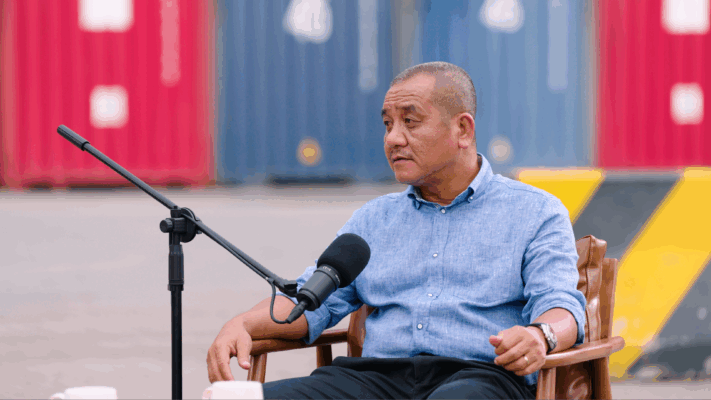
So, how are cost benefits, handling capacities, and operational conditions creating real value for inland waterway transport? And what must logistics enterprises do to transform these natural endowments into core competitive capabilities? Let us hear from Mr. Pham Quang Trung – Transport Director of SOWATCO, a member company of SOTRANS Group, to better understand the opportunities and strategic challenges behind this sector.
Click here to watch the full interview with English subtitles.
Vietnam’s natural advantages in developing inland waterway transport
Interviewer: Welcome Mr. Trung to our program.
Mr. Pham Quang Trung: Hello everyone, I am Pham Quang Trung, Transport Director at Southern Waterborne Transport Corporation (SOWATCO).
Interviewer: In your view, what are the key advantages driving the increasingly vital role of inland waterway transport in the supply chain?
Mr. Pham Quang Trung: Inland waterway transport plays a fundamental role in supply chain logistics, particularly for countries endowed with extensive river networks like Vietnam. We hold a natural advantage with 17,000 km of navigable rivers, including roughly 7,000 km of primary arteries fully capable of accommodating high-tonnage vessels.
This is also a cost-optimal mode for logistics providers due to its high volume capacity per trip, paired with high safety and stability. Additionally, water transport significantly mitigates traffic congestion and relieves pressure on national highways.
Another key factor is its strong alignment with the Government’s green logistics directive to reduce greenhouse gas emissions. This presents a major strategic advantage for the sector’s growth, both today and in the future.
North vs. South inland waterways: differences in infrastructure and operating conditions
Interviewer: Are there noticeable differences in operating conditions between the Northern and Southern regions?
Mr. Pham Quang Trung: Absolutely, there are distinct operational differences between the North and the South.
In the North, the tidal regime is diurnal (one high tide per day), resulting in higher operating costs compared to the South. Geographically, the Northern terrain is mountainous and steep; heavy rainfall causes rapid river level rises. Consequently, navigating vessels through bridges with low vertical clearance (air draft limits) becomes challenging.
Furthermore, waterway infrastructure investments in the North remain inconsistent, with limited focus on channel widening and maintenance dredging. This explains why the Northern inland waterway market has not developed at the same pace as the South.
Conversely, conditions in the South are far more favorable. First, the semi-diurnal tide regime (two high tides per day) allows for more flexible barge maneuvering. Geographically, the flat terrain minimizes gradient issues. Crucially, the primary operating corridor, connecting Ho Chi Minh City, Dong Nai, and Binh Duong to the Cai Mep – Thi Vai deep-sea port cluster, is unrestricted by bridge air drafts, enabling transport operators to maximize vessel payload capacities.
The sole exception is the route from ICD Thu Duc to Cai Mep Port, which is constrained by the air draft of the Sai Gòn Bridge, requiring cargo to be loaded in restricted tiers.
Another factor is that the Southern highway network connecting industrial zones is less developed than in the North, further driving reliance on inland waterways.
Why Do Shippers Choose Inland Waterway Transport?
Interviewer: What are the primary expectations of cargo owners when opting for inland waterway services?
Mr. Pham Quang Trung: Cost is the top priority. Reducing overall logistics spend directly improves profit margins for enterprises.
To illustrate shipping a container from Bac Ninh to Hai Phong by road costs approximately 4.2 million VND. By switching to inland waterways, shippers save roughly 30% in overall costs, excluding additional savings on seaport infrastructure fees and lift-on/lift-off charges.
We see a similar pattern in the South. On the HCMC to Cai Mep corridor, trucking rates hover around 4 million VND per container, whereas barge transport costs just over 1 million VND. The cost-efficiency is substantial on identical routes.
Second is high-volume capacity. A single barge shipment can haul hundreds of containers, alleviating road congestion while driving down unit logistics costs.
Third is cargo safety. Waterways experience significantly fewer accident risks than roadways, providing peace of mind for shippers.
Interviewer: For volume shippers moving hundreds or thousands of TEUs monthly, how significant is this cost benefit?
Mr. Pham Quang Trung: The cumulative impact is huge. For a single container, the savings might seem modest, but for high-volume shippers moving hundreds or thousands of TEUs per month, saving even 50,000 to 100,000 VND per container yields massive bottom-line savings.
SOWATCO’s closed-loop logistics ecosystem
Interviewer: What core operational assets allow SOWATCO to fulfill these market demands?
Mr. Pham Quang Trung: Our primary strength lies in fleet ownership. In the North, we deploy a fleet of four 120-TEU container vessels built in 2018, operating on fixed schedules. In the South, our fleet comprises 22 active barges plus 2 newly launched vessels, providing a total carrying capacity of nearly 4,000 TEUs.
All vessels undergo strict annual maintenance and class surveys to guarantee maximum operational and cargo safety.
Second is our fully integrated, closed-loop logistics ecosystem: encompassing seaports, ICDs, and barge fleets. This integration enables SOWATCO to maintain complete operational autonomy while providing tailored, cost-effective logistics solutions.
Third is fleet versatility. Having diverse vessel sizes is critical because many terminals impose strict length and draft restrictions. During peak port congestion, barge berths may only accept smaller vessels; an operator with only large barges would be unable to service those terminals.
Finally, our crew and operational staff are highly trained with deep maritime expertise. SOWATCO currently serves global ocean carriers such as MSC, Wan Hai, and ZIM, as well as major corporate accounts like Samsung and Toyota. Meeting their strict KPIs demands rigorous compliance with service quality and process control.
Operational expertise and contingency management
Interviewer: You mentioned safety. In day-to-day river operations, how does SOWATCO manage unexpected operational disruptions?
Mr. Pham Quang Trung: Transport incidents, especially on waterways, are often driven by external factors rather than human error. Sudden squalls or storms can cause cargo shifting, while inexperienced handling can lead to collisions.
SOWATCO brings over 50 years of industry heritage. Tracing our origins back to the Southern Waterway Administration established in 1975, our operational experience has been passed down through generations, effectively mitigating risks during cargo handling and vessel operations.
A concrete example is the navigation channel leading into ICD SOTRANS in Thu Duc, which is narrow and shallow. Without precise planning, grounding risks are high. If a barge fails to clear the berth before low tide, it risks getting stranded with hundreds of containers on board, resulting in heavy financial losses.
To solve this, our dispatchers and crew continuously monitor real-time hydrological conditions, coordinating with terminal staff to accelerate loading so vessels depart before water levels drop.
If loading delays occur, we immediately execute an emergency split-shipment plan: containers already on board depart immediately to make the mother vessel’s cut-off time, while remaining containers are hot-shotted via road transport to prevent dropping the entire shipment.
Interviewer: With your extensive experience, what is the most critical factor when handling operational disruptions?
Mr. Pham Quang Trung: Delivering actionable solutions is mandatory. When incidents arise, we build customer trust through accountability and swift contingency execution.
See more: ICDs: From Transit Points to Proactive Links in the Supply Chain
SOWATCO’s long-term strategic outlook
Interviewer: Facing ongoing shifts in the logistics market, what is SOWATCO’s long-term development strategy?
Mr. Pham Quang Trung: First, we aim to expand our market reach and acquire new customer segments.
Second, we will continue restructuring and reinvesting in our integrated, closed-loop ecosystem comprising seaports, ICDs, and barge fleets.
Third, we plan to fully capitalize on strategic geographic corridors. In the South, this includes Ho Chi Minh City, Dong Nai, and the former Binh Duong province; in the North, Bac Ninh and Hai Phong—all of which serve as major national logistics hubs.
Fourth, we are diversifying our cargo portfolio. Beyond containerized cargo, we are expanding into breakbulk and structural cargo (such as steel coils, plates, and sheet metal) that are less susceptible to weather impacts. In the event of adverse market downturns, we can retrofit vessels for bulk transport—a strategic contingency we actively incorporate into our planning.
Additionally, we focus on workforce development and training, while leveraging technology in management, operation, and fleet execution to optimize operating costs. Key initiatives include deploying Transport Management Systems (TMS), real-time GPS tracking cameras, and integrating solar energy to replace traditional power sources in alignment with global green logistics trends.
Interviewer: Based on the insights shared by Mr. Pham Quang Trung, it is evident that inland waterway transport holds a vital position in the broader logistics landscape. With an extensive river and canal network, Vietnam possesses a strong natural endowment to develop this sector.
The operational case study at the access channel to ICD Thu Duc demonstrates that natural advantages can only be fully unlocked when paired with robust execution capabilities and rapid contingency management.
Thank you, Mr. Pham Quang Trung, for joining our program and sharing these practical industry perspectives.
————-
Produced and edited by SOTRANS Group.
|
The ‘Logistics Anchor’ podcast series, a place to share real-world stories from the SOTRANS Group team, a corporation with over 50 years of experience in the logistics sector in Vietnam. Here, every supply chain challenge is viewed through the lens of a practical problem, where solutions are directly tied to operations and the actual needs of businesses. Watch the full series here. |
(SOTRANS Group News)