Vietnam’s oil & gas and energy sectors are entering a vibrant development phase with a series of large-scale offshore projects being deployed simultaneously. Behind these mega-structures lies the paramount requirement to safely transport specialized, oversized, and heavy components, ranging from jacket modules, high-pressure piping systems, and wind turbines to topside structures weighing thousands of tons, from the mainland to offshore sites located hundreds of nautical miles away.
This is a sector with exceptionally stringent technical mandates, highly susceptible to marine weather conditions, and demanding an elevated level of organizational and coordination capability. Given that the value of each component can reach millions of USD, only a handful of enterprises possess enough technical capability, safety compliance, and risk management prowess to qualify for the execution of these projects.
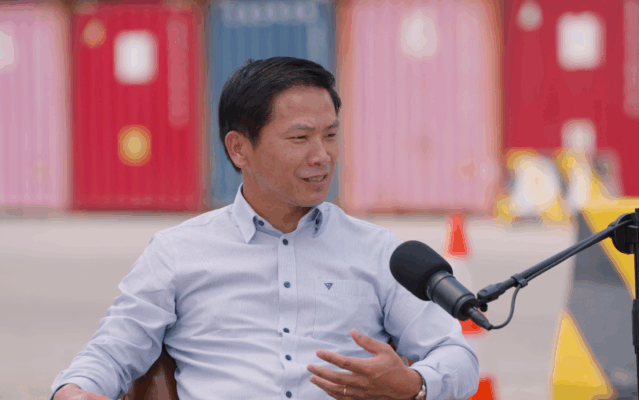
To gain deeper insights into this highly specialized transport field, we sat down for a discussion with Mr. Pham Van Duong – Operations Division Director of VIETRANSTIMEX. He shared the technical requirements, field execution experience, and the step-by-step journey of mastering a sector that was previously dominated almost entirely by international contractors.
Click here to watch the full interview with English subtitles.
Strict Transport Standards – The “Brain-Straining Puzzle” of Oil and Gas Logistics
Interviewer: Hello Mr. Dương. Thank you for participating in our discussion today.
Mr. Pham Van Duong: Hello to you and all our readers. I am Phạm Văn Dương, Chief Operations Officer of VIETRANSTIMEX.
Interviewer: In your opinion, what are the unique characteristics that make oil and gas logistics one of the most technically demanding fields today?
Mr. Pham Van Duong: Across the entire logistics supply chain, oil and gas is one of the sectors with the highest technical demands and the most stringent operational standards. From my perspective, there are five core characteristics.
First is the immense size and payload. To optimize efficiency, most oil and gas components are fully fabricated and assembled on land before being moved offshore. Consequently, during transit, these components are transported as monolithic structures with enormous dimensions and payloads.
Second is the mandatory compliance with international technical standards. Alongside aviation, oil and gas is a sector that applies some of the world’s most rigorous technical standards. Given the immense value of the components, every single phase must be strictly controlled from the outset. The entire execution process must fully comply with Germanischer Lloyd (G.L.) standards, which are currently managed and supervised under the DNV standards system.
Third is the complex construction terrain and the demand for extreme precision. Even moving a thousand-ton structure within a few hundred meters at a port requires meticulous calculations. We must conduct thorough risk assessments along the entire transit route, and when positioning the structure into its exact installation slot, the allowable tolerance is measured only in millimeters.
Fourth is the multimodal and seamless execution process. The transport sequence comprises multiple stages, including inland transport, moving to the jetty, performing the load-out operation onto the barge, marine transit, and offshore installation. Each stage carries its own distinct technical requirements, and marine scopes are always significantly more complex than those on land.
Finally, there is the multi-layered supervision system. We operate under the close oversight of the developer, the insurance provider, technical consultants, and the Marine Warranty Surveyor (MWS). Before any execution takes place, all methodologies must be reviewed, audited, and approved by all involved parties.
Interviewer: In your opinion, what are the greatest challenges that logistics enterprises in this field must face?
Mr. Pham Van Duong: From my perspective, engineering is the core foundation that dictates the success of the entire project. Every scope of work, from initial planning to operational execution, must be built upon a solid technical baseline and real-world feasibility.
First and foremost is developing the transport methodology. A methodology is only truly valuable when it is forged through rigorous site surveys and a comprehensive evaluation of infrastructure conditions, resources, fleet capabilities, equipment, and personnel. We never build plans based on assumptions; we always start from actual execution conditions.
Next is accurately capturing the cargo’s technical specifications, particularly its Center of Gravity (CoG: X, Y, Z coordinates). This data serves as the critical baseline for selecting lifting and transport methods, ensuring the stability of the entire system throughout the execution phase.
Once the methodology is finalized, the next challenge is translating technical calculations into physical operations. This demands a highly experienced execution team and an equipment fleet that strictly complies with International Maritime Organization (IMO) standards. Furthermore, the execution process must be seamlessly coordinated among all project stakeholders, backed by an engineering team capable of handling unforeseen on-site contingencies.
Finally, it comes down to team competency. No matter how well an engineering plan is constructed, the ultimate deciding factor remains the people directly executing it. For high-spec oil & gas and oversized-heavy transport projects, we always deploy our most seasoned crew. This competency is forged over many years, progressing from small-scale projects to handling payloads of thousands of tons. It is this exact accumulation of experience that forms the foundation for VIETRANSTIMEX to meet the ever-escalating demands of mega-scale projects.
Engineering Solutions Empowering VIETRANSTIMEX to Master Oil and Gas Projects
Interviewer: Could you share some signature projects that illustrate how VIETRANSTIMEX tackles complex engineering puzzles in practice?
Mr. Pham Van Duong: Prime examples would be the Sư Tử Đen (Black Lion) and Tê Giác Trắng (White Rhino) oil and gas projects. In the past, the transportation of oversized and heavy components in the oil and gas sector was almost entirely dominated by foreign contractors. However, during execution, we realized that the traditional operation method using SPT (Semi-Trailer/Conventional Hydraulic Trailer) prime movers revealed numerous limitations when handling exceptionally heavy payloads.
Driven by that reality, VIETRANSTIMEX’s engineering team researched a methodology to combine SPMT (Self-propelled Modular Trailer) technology with our existing SPT fleet to create an optimized operational solution fully mastered by Vietnamese engineers. We collaborated directly with the equipment manufacturer to integrate new sensor systems and control units, successfully synchronizing two generations of equipment within just about two months.
Initially, this solution met with considerable skepticism from clients and international underwriters. However, following successful testing and a proven track record of operational stability, the entire methodology was approved.
This served as the springboard for VIETRANSTIMEX to autonomously and successfully transport 1,800-ton oil and gas components, and subsequently, a 2,800-ton structure for the Tê Giác Trắng project. This step-by-step validated our capacity to execute mega-scale oil and gas projects using 100% Vietnamese engineering teams and technical solutions.
Interviewer: Aside from offshore oil and gas projects, VIETRANSTIMEX has also executed many projects with unique technical mandates. Could you share more about these signature milestones?
Mr. Pham Van Duong: A project that left a profound mark on us was the Long Son Petrochemicals (LSP) complex. The challenge of this project lay not in the payload, but in the cargo’s geometric characteristics.
The structure stood 56.5 meters tall and measured 19 meters long, while its footprint (base width) was only 12 meters wide. Most critically, the cargo’s Center of Gravity (CoG) was located at a height of approximately 40 meters, making stability control throughout transit exceptionally stringent.
You can imagine it like a person standing on a very narrow surface; even the slightest shift in the center of gravity can cause a total loss of balance. It was exactly the same with this structure: a mere 1-to-2 centimeter deviation at the base could cause the top of the cargo to tilt by meters, completely altering the stability of the entire system.
To solve this puzzle, VIETRANSTIMEX’s engineers customized a dedicated technical methodology for the project. We combined the SPMT system with specially engineered load-bearing spreader beams to guarantee that the payload was uniformly distributed throughout the transit.
The entire sequence of rolling out the component from the barge onto land and transporting it over 2 kilometers to its final installation slot was continuously monitored to control stability. Even during the marine transit of the barge, the surrounding area was strictly controlled to minimize the impacts of waves and other external forces that could compromise the cargo’s stable state.
This project not only demonstrated our capacity to handle exceptionally high technical challenges but also proved our competence in tailoring solutions to the distinct characteristics of each cargo, rather than applying a one-size-fits-all approach.
Risk Management Experience in Offshore Projects
Interviewer: On paper, engineering methodologies are designed to mitigate risks to absolute zero. However, real-world operations always harbor unpredictable variables. Over the past 50 years, how has VIETRANSTIMEX managed unforeseen on-site contingencies?
Mr. Pham Van Duong: That is correct. In oversized and heavy cargo transport, every single methodology is meticulously calculated prior to execution. Nonetheless, the field always presents factors that cannot be fully simulated, particularly weather, hydrological conditions, or sudden technical failures.
What differentiates a company is not just its ability to forecast risks, but its readiness with contingency plans and the crew’s resilience to make critical decisions in an extremely tight window. I would like to share two scenarios that we still regard as monumental lessons to this day.
See more: Transporting Oversized and Heavy Cargo: When Vietnamese Conquer the “Thousand-Ton” Milestones
5 Minutes Amidst the Gale: Rescuing an 850-Ton Cargo
Mr. Pham Van Duong: In 2019, VIETRANSTIMEX undertook the load-out of an oversized and heavy component weighing approximately 850 tons, measuring 56 meters high, 90 meters long, and 31 meters wide. While this type of cargo fell well within our operational capabilities, the ultimate challenge struck just when the job seemed completed.
Right after the cargo was safely loaded onto the barge, a severe, sudden gale rolled in. The fierce winds caused one of the barge’s primary mooring lines to snap, triggering an imminent risk of the barge spinning and losing stability.
Prior to project execution, we had strictly monitored the hydrometeorological forecasts and utilized specialized IMO-standard software—such as OPTIMO for mooring calculations and MOSES for stability assessments. However, much like any other engineering model, software can only simulate based on forecast data; it cannot pinpoint the exact moment a sudden storm will strike.
Interviewer: How severe was the risk exposure at that moment?
Mr. Pham Van Duong: Once a mooring line snaps, the barge will spin uncontrollably under wind load, leading to the risk of the entire cargo being washed away or capsizing into the sea. Given the immense value of the component and the scale of the project, the financial damage could have reached hundreds of billions of VND.
Fortunately, within our approved methodology, we had proactively deployed tugboats and support vessels on-site as a standby measure. Therefore, the moment the incident occurred, the crew immediately initiated the rescue protocol.
Within just about 5 minutes, the backup winch line was hooked up, and the barge was brought back to a stable state.
In my opinion, the takeaway is not that we resolved the crisis in 5 minutes, but that multiple contingency plans had been thoroughly calculated and pre-engineered. Without that preparation, there would have been no “5 minutes” left to save the project.
The Decision at Vietsovpetro Port – Saving a 2,000-Ton Topside Module
Mr. Pham Van Duong: Another scenario took place in 2011 at Vietsovpetro Port, during the transport of a topside module weighing nearly 2,000 tons. The unique nature of tides in the Southern region features a massive tidal range, fluctuating between 3.5 and 4 meters within a single tidal window.
The entire favorable timeframe to move the cargo was a mere 4 hours (comprising 2 hours for execution and 2 hours for contingency buffer). Right when the trailers were bearing the 2,000-ton payload at the most critical juncture, with one part still on the jetty and the other already on the barge, a heavy downpour caused a failure in the equipment’s electromagnetic system, bringing the entire system to a grinding halt.
Interviewer: How did the team handle the situation at that moment?
Mr. Pham Van Duong: In that do-or-die moment, the VIETRANSTIMEX crew maintained absolute composure. First, the team immediately executed all steps in the pre-established emergency response procedure. However, all attempts to reboot the system yielded no results. The pressure mounted by the minute.
At this critical crossroads, we were forced to make a bold decision: shift the entire advanced technology system into manual operation mode by directly unplugging the electromagnetic system jacks and executing a manual override.
This was a decision that could only be made when the operator possessed a profound understanding of the equipment’s operating principles. If misjudged, manual intervention could have triggered risks far greater than the original failure itself.
Ultimately, the cargo resumed its transit and safely reached its designated slot. To us, this was no longer just a story of a risky decision, but a testament to the fact that field experience must always go hand in hand with an engineering baseline and a rigorous risk management framework.
Embracing Energy Transition Trends and Expanding Project Execution Capabilities
Interviewer: Through your insights, it is evident that technical capability and practical experience form the very foundation that allows VIETRANSTIMEX to successfully execute mega-projects. In the context of the global energy landscape undergoing a powerful transition, what strategic directions has the company set to prepare for the next phase?
Mr. Pham Van Duong: In the specialized field of oversized and heavy cargo transport, technology and technical mandates are constantly evolving. Therefore, investing in human capital and technology is a continuous requirement.
We often tell our team that an engineering methodology is only approved once all identifiable risks have been thoroughly analyzed and mitigated. To achieve this, our engineers must continuously update their knowledge, master new technologies, software, and equipment fleets, while accumulating hands-on experience through each real-world project.
Furthermore, the energy transition trend is unlocking numerous new opportunities for the sector. The development of offshore wind projects demands multiple transport, load-out, and installation phases that share similar technical requirements with current oil and gas projects. Consequently, the experience accumulated in the oil and gas sector can be seamlessly leveraged for renewable energy projects.
For VIETRANSTIMEX, this represents an opportunity to further expand our execution capabilities. We will continue to invest in specialized equipment, elevate team competency, and integrate new technologies to meet the ever-escalating demands of energy projects both domestically and regionally.
Backed by our proven track record in executing numerous mega-scale oil and gas, petrochemical, and energy projects, alongside our position among the Top 50 largest oversized and heavy cargo transport enterprises globally according to the IC Transport 2025 rankings, we expect to remain a trusted partner for Vietnam’s key energy projects in the upcoming phase.
Interviewer: Thank you, Mr. Dương, for sharing these very specific and practical insights. Wishing you and the VIETRANSTIMEX team continued success as you contribute to the execution of Vietnam’s large-scale infrastructure, oil and gas, and energy projects.
————-
Produced and edited by SOTRANS Group
|
The ‘Logistics Anchor’ podcast series, a place to share real-world stories from the SOTRANS Group team, a corporation with over 50 years of experience in the logistics sector in Vietnam. Here, every supply chain challenge is viewed through the lens of a practical problem, where solutions are directly tied to operations and the actual needs of businesses. Watch the full series here. |
(SOTRANS Group News)