Amidst the robust global transition toward clean energy, Vietnam is highly regarded as one of the region’s most promising wind power markets, driven by a coastline stretching over 3,000 km and favorable natural conditions.
However, behind every wind power project lies an exceptionally complex logistics puzzle. Transporting turbine blades measuring nearly 100 meters in length or tower sections weighing hundreds of tons to mountainous or coastal areas requires not only technical capability but also directly impacts investment costs and project schedules.
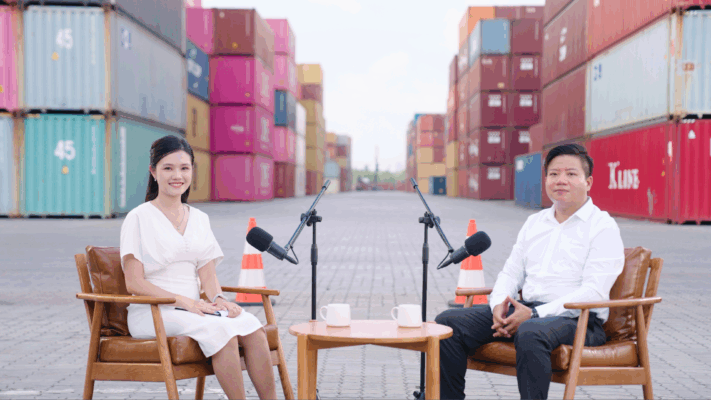
To better understand how this challenge is solved, we sat down for a talk with Mr. Tran Phi Son – Deputy Sales Manager of VIETRANSTIMEX Multimodal Transport Joint Stock Company, a unit with years of experience in executing large-scale wind power projects in Vietnam.
Click here to watch the full interview with English subtitles.
From Corporate Standing to Engineering Capabilities in Wind Power Logistics
Interviewer: It is a great pleasure to welcome Mr. Tran Phi Son to our conversation today to decode the unique journey behind the renewable energy sector. Before diving into the technical expertise, could you briefly share about VIETRANSTIMEX and the company’s standing in the heavy-lift and oversized transport industry?
Mr. Tran Phi Son: VIETRANSTIMEX was established in 1976, formerly known as Multimodal Transport Company II. Through nearly 50 years of development, we are currently one of Vietnam’s leading enterprises in the heavy-lift and oversized transport sector.
According to the IC Transport (UK) rankings in 2024, VIETRANSTIMEX was ranked 38th among the Top 50 largest specialized heavy transport companies globally. In Vietnam, we do not just stop at the role of a transport and installation contractor, but also act as a strategic advisory partner for key national infrastructure projects, contributing to shaping the success of the country’s energy supply chain.
Even a Single Square Meter of Land Is a Cost to Consider
Interviewer: Based on your experience implementing numerous wind power projects, what do you consider to be the most significant characteristic of this sector?
Mr. Tran Phi Son: The defining difference of wind power projects lies in their massive land footprint. According to calculations by many investors, a single wind turbine alone requires about 2–3 hectares of land, which includes the turbine foundation, safety corridors, substations, and internal road networks.
As the site footprint expands, the pressure regarding site clearance costs increases accordingly. Therefore, for project owners, every single square meter of land represents a cost that must be carefully considered.
That is precisely when the role of a logistics provider extends far beyond mere transportation. We get involved right from the planning phase to collaborate with the investor in developing the most optimal transport methodology, aiming to minimize the physical footprint impacted during construction, thereby directly helping the investor save on overall project costs.
Interviewer: How do the oversized dimensions of wind power components create challenges in practice?
Mr. Tran Phi Son: To easily visualize the complexity of this task, we can look at the dimensions of the components first.
A modern wind turbine blade typically measures 80–100 meters in length, equivalent to nearly five container trucks lined up bumper-to-bumper. Meanwhile, the diameter of a tower section can be as large as a two-story house.
Additionally, there is the terrain factor. To achieve optimal wind harvesting efficiency, projects are usually constructed on hilltops, mountainous regions, or coastal areas where transport infrastructure remains highly limited.
The combination of giant components and complex terrain makes transportation one of the most challenging items of the entire project.
Consequently, project owners and EPC contractors do not just look for a provider with a sufficient fleet of transport vehicles; they require a partner with field survey experience, a deep understanding of infrastructure conditions in Vietnam, and the capability to engineer technical plans precise to every detail. This ensures that components are transported safely, on schedule, and at an optimized cost.
The Journey of Delivering Giant Wind Blades to the Site
Interviewer: Could you share more details about the process of transporting a wind turbine blade measuring 80–100 meters in length?
Mr. Tran Phi Son: For components ranging from 80m to 100m long, transporting them seamlessly from seaports to treacherous terrains like high mountains or offshore sites is certainly a difficult puzzle with many variables. Therefore, the entire transport methodology is a chain of complex calculations. The difficulty lies not only in moving the components but also in the entire infrastructure system supporting the transport process.
The first challenge for investors is facing unforeseen budget overheads for widening and reinforcing the road network from national highways down to each specific turbine position.
The second is the pressure on seaport infrastructure. Given that wind power components are specialized out-of-gauge and heavy-lift cargo, they require dedicated berths capable of handling heavy cargo, while the number of ports meeting these standards in Vietnam remains limited. This means project owners and EPC contractors cannot always select the port of entry closest to the project site.
After leaving the port, the transport journey must also navigate a dense network of obstacles along national highways, ranging from power grids and overpasses to population density and infrastructure bottlenecks.
To resolve these issues, VIETRANSTIMEX implements a strict process well before transportation begins. This ranges from detailed field surveys to assess every route, conducting transit simulations, and engineering the most optimal methodology, followed by drafting plans to clear or temporarily relocate obstacles along the route. Throughout this process, we work closely with local authorities and communities to ensure a smooth route and absolute safety.
Interviewer: So, the inability to proactively choose the port of entry closest to the project is also a significant challenge?
Mr. Tran Phi Son: Exactly. However, that is just an external factor. Another challenge lies in specialized equipment capacity.
Currently, not many enterprises in Vietnam own the equipment systems that meet the requirements for transporting new-generation wind turbines, which are growing larger in size.
Recognizing this trend early, before the wind power market boomed, VIETRANSTIMEX proactively invested in specialized equipment systems to meet the most stringent transport engineering requirements of both domestic and international projects.
See more: [Interview] The Beverage Supply Chain – When Logistics Is The Anchor For Quality
Untangling Infrastructure Bottlenecks with Specialized Transport Engineering Solutions
Interviewer: From the advisory phase to the official project execution, how long does VIETRANSTIMEX typically partner with the project owner?
Mr. Tran Phi Son: Typically, this process spans from six months to a year, depending on the scale and complexity of each project, and begins right from the project preparation phase.
The primary reason lies in site clearance, which is closely tied to the land-use planning of each local authority. Once VIETRANSTIMEX and the project owner agree on the optimal transport methodology, the owner must submit this plan to the Provincial People’s Committee for approval or corresponding zoning adjustments.
This means that, alongside technical consulting, VIETRANSTIMEX needs to stand by the project owner when working with departments and agencies to ensure legal compliance and the alignment of land-use planning for the project. These approval procedures are usually time-consuming and can take up to a year before official field execution can begin.
Interviewer: It appears that the majority of the project preparation time is spent on site clearance. How has VIETRANSTIMEX helped project owners alleviate the pressure of site clearance costs and volume?
Mr. Tran Phi Son: Exactly. For wind power projects, the unforeseen costs incurred during transportation do not usually stem from moving the components themselves, but primarily from site clearance and tackling infrastructure bottlenecks along the route.
Therefore, right from the survey and methodology-engineering phase, we always aim to minimize the physical land footprint that needs to be impacted.
To achieve this, VIETRANSTIMEX combines the practical experience of our engineering team with modern specialized equipment systems to construct a transport methodology tailored to existing infrastructure conditions.
To help readers visualize, a modern wind turbine blade is about 80–100 meters long, equivalent to nearly five container trucks lined up bumper-to-bumper. If transported using conventional methods, the vehicle would require a massive turning radius at bends, leading to the necessity of widening roads and clearing additional land.
In contrast, VIETRANSTIMEX utilizes specialized equipment systems capable of lifting and rotating the blade right on the transport vehicle. By adjusting the blade’s inclination angle to closely “hug” the curves or clear overhead obstacles, we can significantly narrow down the vehicle’s turning radius. This translates directly into reducing the site clearance area and minimizing the relocation of existing structures, crops, and infrastructure, thereby helping the project owner achieve substantial cost savings and shorten project deployment timelines.
Interviewer: This must be a highly demanding technical requirement, as controlling an out-of-gauge, heavy-lift cargo block rotating mid-air is by no means simple?
Mr. Tran Phi Son: Correct. This is a challenge that demands extremely high precision because every maneuver involves components of exceptionally large dimensions and payloads. Just a minor deviation could compromise safety and the entire transport schedule.
However, the value of the solution does not lie in the equipment itself, but in the capability to integrate the experience and competence of the team with advanced transport engineering and modern equipment.
Saving 60% in Site Clearance Costs for a French Investor
Interviewer: Could you share a specific example of a “tough puzzle” where VIETRANSTIMEX successfully helped a client optimize costs significantly?
Mr. Tran Phi Son: One of our hallmark projects is a wind power project in Dak Lak, invested by a French energy corporation.
The greatest challenge of the project stemmed from the mountainous terrain of the Central Highlands and the site clearance costs. The transport route passed through areas concentrated with high-economic-value industrial crops such as durian, pepper, and coffee, right during the harvest season. If we had widened the road using conventional methods, the crop compensation costs would have been massive.
After conducting field surveys, the VIETRANSTIMEX engineering team collaborated with the project owner to review the entire transport methodology and the internal road network design.
From there, we proposed a distinct transport approach, transporting the blade at an elevated angle mid-air, lifting the blade tip to minimize the land footprint occupied and the number of crops needing clearance.
Interviewer: What kind of efficiency did this solution bring to the project owner?
Mr. Tran Phi Son: While I cannot disclose specific numbers due to confidentiality agreements, based on the final evaluation report, the project owner confirmed that VIETRANSTIMEX’s solution helped them save 60% in site clearance and crop compensation costs compared to the original budget.
This result not only helped the project cross the finish line with high economic efficiency but also served as a solid foundation for the investor to continue trusting and choosing VIETRANSTIMEX for their upcoming key wind power projects next year.
Multimodal Transport Solutions for Infrastructure Challenges in Quang Tri
Interviewer: Could you share a specific example of a “tough puzzle” where VIETRANSTIMEX successfully helped a client optimize costs significantly?
Mr. Tran Phi Son: One of our hallmark projects is a wind power project in Dak Lak, invested by a French energy corporation.
The greatest challenge of the project stemmed from the mountainous terrain of the Central Highlands and the site clearance costs. The transport route passed through areas concentrated with high-economic-value industrial crops such as durian, pepper, and coffee, right during the harvest season. If we had widened the road using conventional methods, the crop compensation costs would have been massive.
After conducting field surveys, the VIETRANSTIMEX engineering team collaborated with the project owner to review the entire transport methodology and the internal road network design. From there, we proposed a distinct transport approach, transporting the blade at an elevated angle mid-air, lifting the blade tip to minimize the land footprint occupied and the number of crops needing clearance.
Interviewer: What kind of efficiency did this solution bring to the project owner?
Mr. Tran Phi Son: While I cannot disclose specific numbers due to confidentiality agreements, based on the final evaluation report, the project owner confirmed that VIETRANSTIMEX’s solution helped them save 60% in site clearance and crop compensation costs compared to the original budget. This result not only helped the project cross the finish line with high economic efficiency but also served as a solid foundation for the investor to continue trusting and choosing VIETRANSTIMEX for their upcoming key wind power projects next year.
Interviewer: Apart from the project in Dak Lak, could you share another case where VIETRANSTIMEX had to completely alter the transport methodology to solve a practical problem?
Mr. Tran Phi Son: A prime example is a wind turbine blade replacement project in Quang Tri for a leading German turbine manufacturer.
This was a project we previously executed in 2021. However, after about 5 years, the infrastructure along the route from Hon La Port to the site had changed significantly. Many new residential areas had formed, bringing houses, trees, and infrastructure facilities. If we had continued to use the old route, the project owner would have faced massive site clearance costs and caused significant disruptions to the local community.
After surveying and evaluating multiple scenarios, VIETRANSTIMEX decided to pivot the transport methodology, combining inland waterway and road transport to bypass the infrastructure bottlenecks along the route.
This solution, integrated with specialized equipment, enabled all components to be transported safely to the site without displacing a single household or cutting down a single tree, while preserving the existing infrastructure of the area. It not only saved substantial site clearance costs but also minimized environmental and community impacts. As a result, our German partner highly appreciated VIETRANSTIMEX’s advisory and execution capabilities, laying the groundwork for future cooperation opportunities.
Human Element as the Deciding Factor in the Era of Machinery
Interviewer: To be able to advise on and execute such complex methodologies, what do you consider to be the core capability that creates the difference for VIETRANSTIMEX?
Mr. Tran Phi Son: In my opinion, the most critical factor remains the human element.
Modern machinery and equipment are necessary conditions, but only humans can survey the site, analyze infrastructure conditions, assess risks, and engineer the most optimal plan for each specific project.
VIETRANSTIMEX’s engineering team possesses years of experience executing heavy-lift and out-of-gauge projects across Vietnam. Thanks to a deep understanding of the terrain characteristics, transport infrastructure, and technical requirements of each region, we can engineer plans precise to every detail, mitigating risks right from the preparation phase.
The second factor is equipment capacity.
A great methodology only matters when the enterprise owns an equipment system capable of bringing that plan to life. Therefore, VIETRANSTIMEX always proactively invests in and maintains a broad and deep fleet of specialized equipment, while continuously upgrading our operational capabilities to satisfy the most stringent transport scenarios of next-generation wind power projects.
Interviewer: How is VIETRANSTIMEX’s execution process standardized to effectively integrate human capability with equipment systems?
Mr. Tran Phi Son: Our process begins with proactivity. We proactively partner with clients right from the project preparation phase. The subsequent execution process goes through multiple rigorous stages: from field surveys, infrastructure condition assessments, and transport methodology engineering, to site clearance planning, followed by continuous fine-tuning and solution optimization based on real-world dynamics until the final execution plan is achieved.
It can be said that the majority of a logistics project’s value is generated before the very first truck rolls out.
Interviewer: So it can be understood that VIETRANSTIMEX is not just a transport contractor, but a partner accompanying clients throughout the entire project implementation?
Mr. Tran Phi Son: Exactly. Investors today do not just need an enterprise capable of moving heavy-lift and out-of-gauge cargo. They require a partner who can get involved right from the planning, risk assessment, and technical advisory phases until all equipment is safely delivered to the installation position.
That is also the strategic direction VIETRANSTIMEX has pursued for many years: providing integrated, total logistics solutions rather than just offering conventional transport services.
Heading Toward Large-Scale Energy Projects in the Region
Interviewer: Currently, more and more enterprises are entering the wind power logistics market. In your opinion, what is VIETRANSTIMEX’s primary competitive advantage?
Mr. Tran Phi Son: Competition within the industry is intensifying as many companies invest heavily in equipment and human resources.
However, VIETRANSTIMEX’s strategic direction is not just to be a transport contractor, but to become an integrated logistics solution provider for energy projects.
Beyond focusing on our strengths in heavy-lift and out-of-gauge (OOG) road transport, we have expanded into specialized installation services, multimodal transport especially heavy-lift ocean freight and collaborated with international partners to create synergy in both equipment capacity and experience for executing large-scale projects.
Our goal is not only to maintain our leading position in Vietnam but also to expand operations into developing energy markets within the region, such as Laos, Cambodia, and the Philippines.
Interviewer: How do you see VIETRANSTIMEX preparing for future wind power development trends?
Mr. Tran Phi Son: Wind power technology is evolving rapidly. Turbine capacities are growing larger, leading to a significant increase in the size and weight of components. To stay ahead of this trend, VIETRANSTIMEX is focusing on three strategic pillars:
First, continuing to invest in crane systems and transport vehicles with higher payloads to accommodate next-generation components.
Second, expanding our capability to serve offshore wind projects through partnerships to deploy specialized vessels and equipment.
Third, enhancing cooperation with international partners to elevate our competitive edge and progressively expand our regional market share.
We are confident that with thorough technical infrastructure preparation and a clear strategic vision, VIETRANSTIMEX will continue to be the trusted choice for large-scale and complex energy projects in the future.
Interviewer: Thank you very much, Mr. Tran Phi Son, for these highly practical and valuable insights. Wishing you and VIETRANSTIMEX continued success as you accompany key energy projects in Vietnam and across the region.
————-
Produced and Edited by SOTRANS Group.
|
The ‘Logistics Anchor’ podcast series, a place to share real-world stories from the SOTRANS Group team, a corporation with over 50 years of experience in the logistics sector in Vietnam. Here, every supply chain challenge is viewed through the lens of a practical problem, where solutions are directly tied to operations and the actual needs of businesses. Watch the full series here. |
(SOTRANS Group News)